
Manufacturing Marketing Agency: More RFQs, No Generic Runaround
You build precision products. Steel ramps rated for 30,000 lbs. Custom fabricated dock equipment. CNC-machined parts with tolerances measured in thousandths. Your work speaks for itself on the plant floor.
But your website? It looks like a relic from the early days of the internet. Your spec sheets take 8-10 seconds to load. The contact form is buried three clicks deep. And the last agency you hired wrote blog posts titled "5 Tips for Industrial Efficiency" -- content so generic it could have been written for a laundromat.
Here is the problem: less than 100 agencies in the US have repeated manufacturing experience. The rest are generalists who run the same playbook for dentists, restaurants, and roofers -- then wonder why it doesn't work when your average order is $25,000 and your sales cycle is 6 months.
This guide is for manufacturers who have been burned by that approach. We'll cover what a real manufacturing marketing agency does differently, show you a real case study with before-and-after numbers, break down pricing, and give you a checklist for evaluating any agency before you write another check.
If 70% of B2B purchasing research now happens online before a buyer ever contacts you, and your website isn't answering the technical questions procurement managers are asking -- you're losing jobs to competitors you've never even heard of.
Why Most Marketing Agencies Fail Manufacturers
Manufacturing is not like marketing a restaurant or a dental practice. The buying process is different. The audience is different. The content requirements are different. And most agencies don't respect those differences.
We hear the same story from nearly every manufacturer we talk to: "You hired a firm and they didn't understand your product." They wrote blog posts that were embarrassing to share with customers. They ran Google Ads targeting "industrial supplies" instead of the actual product terms your buyers search. They asked you to post on Instagram three times a week when your customers are procurement managers, not consumers.
The 5 Ways Generic Agencies Waste Manufacturing Budgets
1. They write content that embarrasses you
Blog posts like "The Future of Manufacturing" or "Why Quality Matters" that say nothing specific about your products, capabilities, or industry. The engineer reading it knows immediately that the writer has never set foot on a plant floor.
2. They target the wrong keywords
Broad terms like "industrial solutions" or "manufacturing services" instead of product-specific terms like "portable aluminum yard ramp 20,000 lb capacity" or "custom steel dock leveler." The specific terms are what your actual buyers type into Google.
3. They measure the wrong things
They send you reports full of social media impressions and blog page views. You don't need 10,000 blog visitors. You need 10 qualified RFQs from procurement managers who are ready to specify your product on a project.
4. They treat your website as a brochure
Your website should be a sales tool with product pages that answer every technical question a buyer has -- specs, load ratings, capacities, lead times, customization options. Instead, they built a 5-page brochure site with a stock photo of a handshake on the homepage.
5. They don't understand your sales cycle
Manufacturing sales cycles run 3-12 months. The buyer researches online, downloads spec sheets, gets internal approval, sends an RFQ, negotiates, and then places an order. A "click to buy" approach built for consumer products makes no sense in this world.
The Real Cost of a Bad Agency
"We spent $20,000 last year on social media advertising, PPC, radio ads, magazine ads, and marketing software. But we're not sure what worked and what didn't!" -- This is what we hear from manufacturers who hired generalists. $20,000 spent with zero attribution. No tracking on quote request forms. No idea which channel actually drove inquiries. That is not a marketing budget. That is a donation.
What a Manufacturing Marketing Agency Actually Does
A manufacturing marketing agency builds your digital presence around how jobs actually come in -- not how a textbook says marketing should work. Every service is built around one outcome: getting qualified inquiries from people who are ready to specify or purchase your products.
| Service | What It Means for Manufacturers | Outcome |
|---|---|---|
| Manufacturing SEO | Ranking for product-specific terms your buyers actually search. Spec-driven product pages with schema markup. | Organic traffic from engineers and purchasing agents |
| Website Redesign | Product pages with specs, RFQ forms, fast load times. Not a 5-page brochure with stock photos. | More quote requests from your website |
| Google Ads | Search campaigns targeting exact product queries. No broad match waste on "industrial supplies." | Immediate visibility for high-intent searches |
| Technical Content | Product pages, application guides, spec comparisons -- not "5 Tips" blog posts. Written by people who understand load ratings and tolerances. | Technical resources that build trust and rank |
| Inquiry Tracking | Call tracking, form submission attribution, CRM integration. Know exactly which channel drives each RFQ. | Clear ROI on every marketing dollar |
| Local SEO | Google Business Profile optimization for "near me" searches. Critical for manufacturers serving regional markets. | Map pack visibility in your service area |
Notice what is not on that list: TikTok videos, influencer partnerships, or a "social media content calendar." Those services have a place in consumer marketing. They don't drive RFQs from procurement managers evaluating dock equipment.
A manufacturing-focused agency measures success in qualified inquiries, not impressions. The question is never "how many people saw our Instagram post?" It is "how many quote requests came through the website this month, and which pages drove them?"
Case Study: How We Rebuilt a Ramp Manufacturer's Digital Pipeline
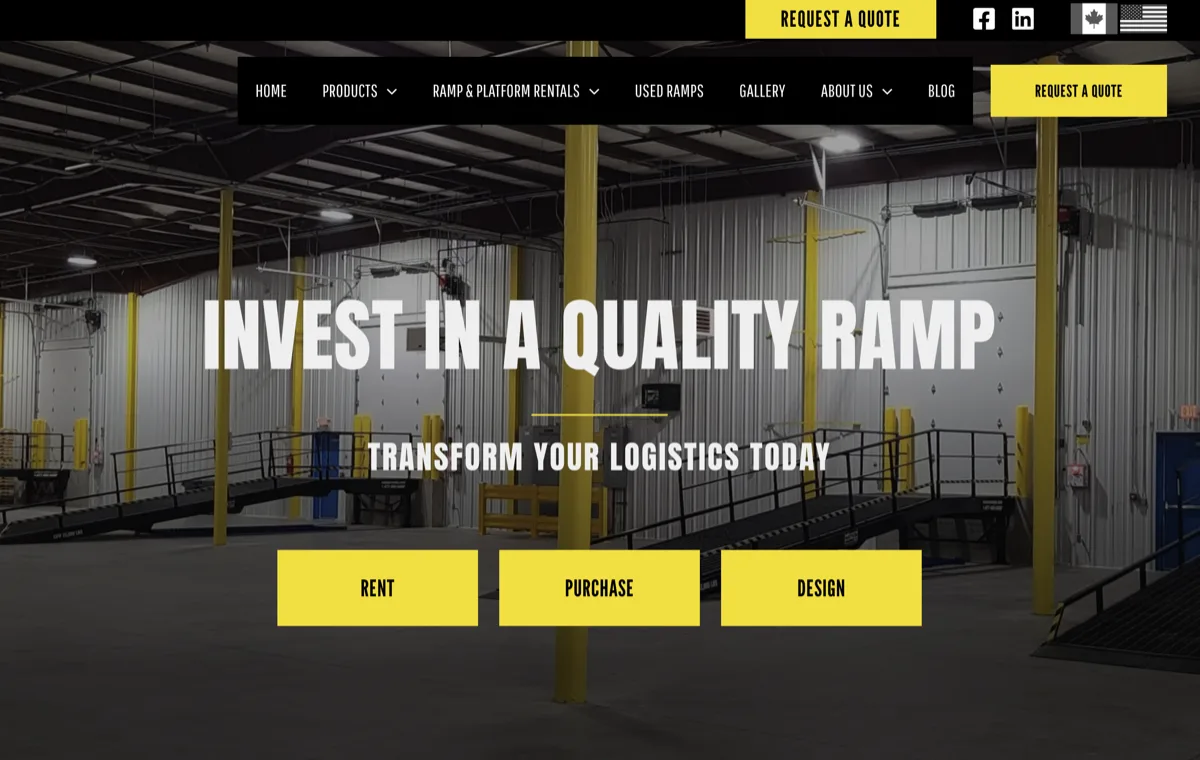
An industrial ramp manufacturer came to us with a dated website, zero organic visibility, and no clear path from product page to quote request. Their site functioned as a product catalogue, not a sales tool. Here is what we did and what happened.
The Problem
0
Product pages ranking on page 1
8-10s
Average page load time
0
RFQ forms on product pages
Their website had product listings with basic descriptions but no technical specifications, no load ratings, no capacity data -- the exact information procurement managers need to evaluate and specify equipment. The contact form was buried on a separate page. Spec sheets were PDFs that took forever to load on mobile.
What We Built
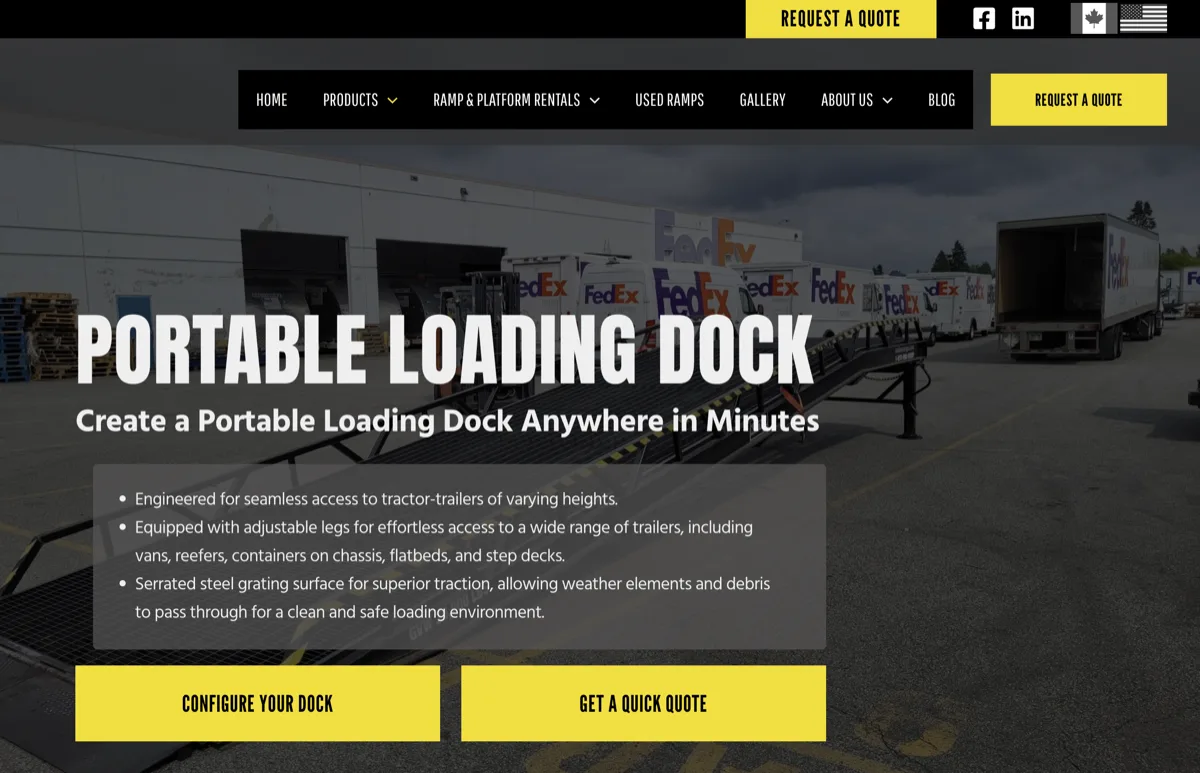
- +Spec-driven product pages -- Every ramp product got its own page with capacity, dimensions, weight, material specs, and application photos. Written in the language engineers and purchasing agents use.
- +RFQ form on every product page -- Not just a generic contact form. A quote request form pre-populated with the product name, asking for quantity, delivery location, and timeline. Reduced friction from "I'm interested" to "I need a quote."
- +Product schema markup -- Structured data telling Google exactly what each product is, its specifications, and its category. This helps product pages appear in rich search results.
- +Page speed optimization -- Compressed images, lazy loading, code splitting. Performance score went from 60 to 91. Spec sheets load in under 2 seconds now.
- +Product-specific keyword targeting -- Optimized each page for the exact terms buyers search: "steel yard ramp 30,000 lb capacity," "portable loading dock ramp," "aluminum warehouse ramp."
The Results
60 → 91
Performance score improvement
Page 1
Rankings for product-specific terms
RFQs
Coming through product pages
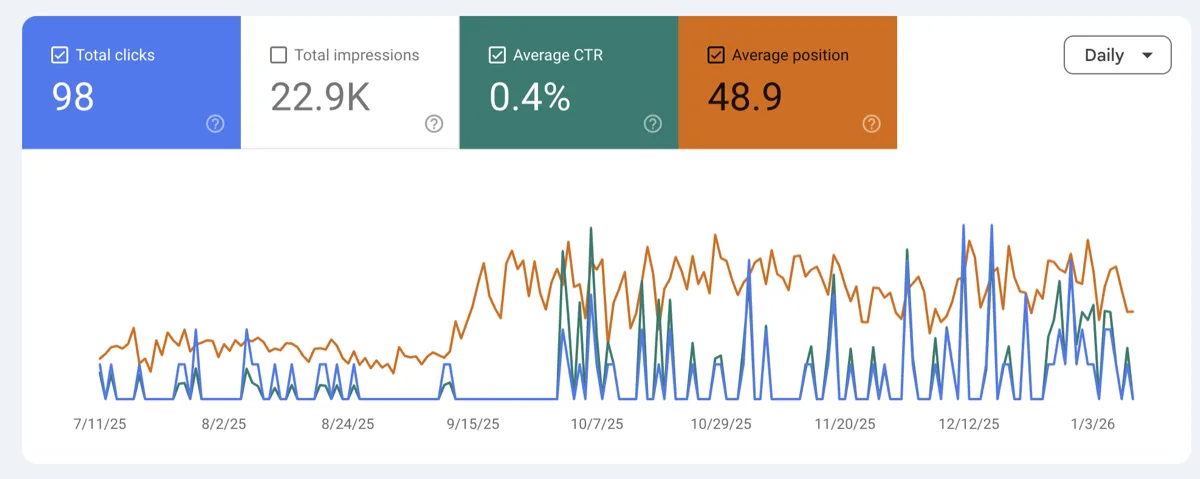
The site went from invisible to ranking for the product terms procurement managers actually search. More importantly, the redesigned product pages with inline RFQ forms turned browsers into qualified inquiries. Every quote request is tracked and attributed to the specific product page and search term that drove it.
Case study: Nation Ramps (named client)
That ramp manufacturer is not hypothetical -- it is Nation Ramps, a real client we still run. We manage their Google Ads across the USA and Canada, spanning 20+ product categories and 5+ industries, and the site's interactive ramp designer pre-qualifies leads before a quote request ever lands on the sales desk -- so the RFQs that come through are spec-complete and ready to price, not tire-kicker inquiries. See the full build on the Nation Ramps case study.
Free Manufacturing Website Audit
We'll review your website, your top competitors, and your current search visibility -- then tell you exactly where you're losing quote requests and what to fix first. No obligation. No generic PDF report. A real assessment from people who understand manufacturing.
Request Your Free AuditTakes 2 minutes. We'll get back to you within 24 hours.
Manufacturing SEO: Ranking for What Purchasing Actually Searches
The biggest SEO mistake manufacturers make is targeting broad industry terms. "Industrial equipment" gets searches, sure. But the person typing that into Google could be a college student writing a paper. The person typing "hydraulic dock leveler 40,000 lb capacity price" is a purchasing agent with a PO number ready.
Manufacturing SEO is about ranking for the specific product terms, part numbers, and technical specifications that your actual buyers search. The search volume is lower, but the conversion rate is dramatically higher because every click has real purchase intent behind it.
Product-Specific Keyword Strategy
| Generic Keywords (Waste) | Product-Specific Keywords (Revenue) |
|---|---|
| industrial equipment | steel yard ramp 30,000 lb capacity |
| loading dock solutions | portable aluminum dock ramp 16 ft |
| manufacturing services | custom CNC machining titanium parts |
| material handling | gravity roller conveyor 24 inch wide |
| industrial products | forklift ramp 25,000 lb price |
Spec-Driven Product Pages
Every product you manufacture should have its own page -- not a listing in a catalogue, but a full page with:
- 1.Technical specifications (dimensions, capacity, load rating, materials, weight)
- 2.Application photos and installation examples
- 3.Downloadable technical data sheets (optimized for fast loading)
- 4.Customization options and lead times
- 5.An RFQ form right on the page -- no extra clicks
- 6.Product schema markup for rich search results
This is the content that ranks for product-specific searches. This is what the engineer specifying your product needs to see before they put your company on the approved vendor list. And this is what most manufacturer websites are missing entirely.
Schema Markup: The Technical Edge
Schema markup tells search engines exactly what your product is -- its name, category, specifications, manufacturer, and availability. Most manufacturer websites have zero structured data. Adding product schema helps your pages appear with rich snippets in search results, which increases click-through rates by 20-30% in our testing.
Manufacturing Website Design That Generates RFQs
Most manufacturer websites function as product catalogues, not sales tools. Contact forms are buried on a separate page. Spec sheets are bloated PDFs. The site looks like it hasn't been touched since 2012. And the company wonders why all their inquiries still come from trade shows.
A manufacturing website built to generate quote requests looks fundamentally different from a brochure site. Here is what separates the two.
Brochure Website vs. RFQ-Generating Website
| Brochure Site (What You Have) | RFQ Machine (What You Need) |
|---|---|
| One "Contact Us" page buried in nav | Quote request form on every product page |
| Generic product descriptions | Full specs: capacity, dimensions, materials, tolerances |
| Stock photos of factories | Real product photos and application images |
| PDF spec sheets (slow, not indexed) | HTML spec pages (fast, indexed by Google) |
| 8-10 second load times | Under 3 seconds on mobile |
| No tracking on forms or calls | Every RFQ attributed to source, keyword, and page |
| "About Us" page about your founding | Capability pages: certifications, equipment list, capacity |
The Quote Request Button Rule
If a procurement manager is looking at a product page for your 30,000 lb steel yard ramp, the next action should be obvious: "Request a Quote." Not "Contact Us" on a separate page. Not a phone number in the footer. A quote button, right there, that pre-fills the product they're looking at.
Every extra click between "I want this product" and "I'm requesting a quote" loses you potential inquiries. We've seen manufacturers double their RFQ volume simply by adding product-specific quote forms to existing product pages -- no other changes needed.
Mobile Speed Matters More Than You Think
"Our buyers don't use phones" is something we hear constantly from manufacturers. The data says otherwise. Over 50% of B2B research happens on mobile devices -- often from plant floors, job sites, or during travel. If your spec sheets take 10 seconds to load on a phone, that engineer is going to your competitor's site instead. Speed is not a nice-to-have for manufacturing websites. It is a qualifier.
Google Ads for Manufacturers: Capturing Active Buyers
While SEO builds long-term organic visibility, Google Ads puts your products in front of buyers who are searching right now. For manufacturers, this is particularly powerful because the people typing product-specific queries into Google are often deep in an active purchasing process.
Why Broad Match Kills Manufacturing Budgets
The number one reason manufacturers say "we tried PPC and it didn't work" is because their agency used broad match keywords. When you bid on "ramp" in broad match, you're paying for clicks from people searching for wheelchair ramps, skateboard ramps, highway on-ramps, and video game ramp jumps. Your budget evaporates on irrelevant traffic.
| How Generic Agencies Set It Up | How It Should Be Set Up |
|---|---|
| Broad match: "industrial ramp" | Exact/phrase match: "steel yard ramp 30,000 lb" |
| One ad group for all products | Separate campaigns per product category |
| Generic landing page (homepage) | Product-specific landing page with RFQ form |
| No negative keywords | Extensive negative keyword lists (consumer terms, competitors, DIY) |
| Tracking: clicks and impressions | Tracking: RFQ form submissions and phone calls |
Manufacturing Google Ads Cost Data
Google Ads costs for manufacturing vary by product and competition, but here are typical ranges:
Average CPC (Manufacturing)
$2-$8
Product-specific terms with purchase intent
Cost Per Qualified RFQ
$50-$200
When properly targeted with exact match
At $100 per qualified inquiry and $25,000 average order value, the math is simple. Even at a 20% close rate, every $100 in ad spend that produces a qualified RFQ has the potential to return $5,000 in revenue. That is a 50:1 return -- if the campaigns are built correctly. The agencies that failed you before probably never got close to those numbers because they were burning budget on broad match traffic.
Generic Agency vs. Industrial Marketing Specialist
This is the comparison that matters. Not "which agency has the nicest website" or "which one charges the least." But which one actually understands your business enough to produce results. Here is how a generic digital marketing agency stacks up against one that specializes in manufacturing and industrial.
| Factor | Generic Agency | Industrial Specialist |
|---|---|---|
| Content Quality | "5 Tips for Industrial Efficiency" | Product pages with real specs, load data, and application guides |
| Keyword Strategy | Broad industry terms with high search volume | Product-specific terms purchasing agents search |
| Success Metric | Blog traffic, social followers, impressions | Qualified RFQs and quote requests |
| Website Approach | 5-page brochure with stock photos | Spec-driven product pages with inline RFQ forms |
| Google Ads | Broad match keywords, homepage landing page | Exact match product terms, dedicated landing pages |
| Buyer Understanding | Calls them "leads" and "decision makers" | Knows the difference between the engineer specifying it and purchasing |
| Reporting | Vanity metrics: impressions, clicks, CTR | Revenue metrics: RFQs by source, cost per inquiry, close rate |
| Industry Knowledge | Doesn't know your SIC code or competitors | Understands RFQ cycles, procurement, and custom fabrication |
The price difference between a generic agency and an industrial specialist is usually small -- maybe 10-20% more per month. The results difference is enormous. A generic agency might generate blog traffic. A specialist generates quote requests from procurement managers who are evaluating your products right now.
How Much Does Manufacturing Marketing Cost?
Most agencies in this space force you to fill out a form and sit through a sales call before they mention pricing. We think that wastes everyone's time. Here is what manufacturing marketing actually costs in 2026.
| Package | Monthly Investment | What's Included | Best For |
|---|---|---|---|
| Starter | $2,500-$5,000 | SEO foundations, 5-10 product page optimizations, Google Business Profile, basic analytics setup | Manufacturers with existing websites that need optimization |
| Growth | $5,000-$10,000 | SEO + Google Ads, 20+ product pages, technical content creation, RFQ tracking, monthly reporting | Manufacturers ready to build a digital inquiry pipeline |
| Scale | $10,000-$20,000 | Full website redesign, SEO, Google Ads, technical content program, CRM integration, call tracking, dedicated account manager | Manufacturers who want to dominate their product categories online |
The ROI Math
Average order value: $25,000
Monthly marketing investment: $7,500
New qualified RFQs per month: 10
Close rate: 20%
New orders per month: 2
Monthly revenue from marketing: $50,000
ROI: 6.7x return
Even at conservative numbers -- 10 RFQs, 20% close rate -- the math works. One order per month pays for the entire marketing program and then some. Two orders per month and you are looking at a 6-7x return.
Compare this to the $20,000 you spent last year on a scattered mix of social media, radio ads, and marketing software with no idea what worked. A focused manufacturing marketing program costs the same or less -- and tracks every dollar to a specific result.
Manufacturing Sub-Verticals We Serve
"Manufacturing" is not one industry. A ramp manufacturer has completely different buyers, products, and sales processes than a CNC machine shop. We build marketing programs around your specific vertical, not a one-size-fits-all manufacturing template.
Ramp & Dock Equipment
Yard ramps, dock levelers, dock plates, edge-of-dock levelers, portable ramps
Product-specific SEO targeting capacity, material, and application terms. RFQ-focused product pages with full load rating specifications.
Custom Fabrication
Structural steel, sheet metal, welding, assembly, finishing
Capability-driven pages showcasing certifications, equipment lists, and project portfolios. Local SEO for regional fabrication services.
CNC & Machine Shops
CNC milling, turning, Swiss machining, EDM, grinding
Tolerance and material-specific content. Targeting search terms like "precision CNC machining titanium" and "5-axis milling services."
Conveyor & Material Handling
Belt conveyors, roller conveyors, sortation systems, automated material handling
System-level content targeting facility managers and operations directors. Integration-focused technical resources.
Industrial Safety Equipment
Safety barriers, guardrails, bollards, fall protection, safety gates
Compliance-driven content targeting safety managers and facility directors. OSHA-referenced technical resources.
Process & OEM Manufacturing
Contract manufacturing, OEM parts, assemblies, private label
Industry-specific landing pages targeting procurement teams in automotive, aerospace, medical, and electronics.
Each of these sub-verticals has unique search patterns, buyer personas, and sales cycles. A generic "manufacturing marketing" approach treats them all the same. We don't. Your program is built around your specific products, your specific buyers, and the specific terms they search when they're ready to issue a PO.
The "We Get All Our Business from Trade Shows" Problem
We hear this from nearly every manufacturer on our first call. And they're not wrong -- trade shows, referrals, and word of mouth have driven manufacturing sales for decades. But they're not telling the full story.
The Data They Don't See
- 70% of B2B purchasing research now happens online before a buyer contacts any vendor. (Gartner)
- 67% of the buyer's journey is completed digitally before they ever talk to sales. (SiriusDecisions)
- The average B2B buyer consults 13 content resources before making a purchase decision. (FocusVision)
That means for every RFQ you receive from a trade show, there are multiple procurement managers who researched your product online -- and went with a competitor because their website answered questions yours didn't.
Trade Show ROI vs. Digital ROI
| Factor | Trade Show | Digital Marketing |
|---|---|---|
| Annual Cost | $30,000-$100,000+ per show | $30,000-$120,000/year (ongoing) |
| Active Duration | 3-4 days per event | 365 days, 24/7 |
| Reach | People who attend that show | Everyone searching for your products online |
| Attribution | Hard to track -- business cards, badge scans | Every inquiry tracked to source, keyword, and page |
| Compounding Value | Starts over every year | SEO rankings and content compound over time |
This is not an argument to stop going to trade shows. It is an argument to stop relying on them as your only pipeline. Trade shows work great for relationship building and product demos. Digital marketing captures the buyers who research online between events -- the ones your competitors are already reaching.
The manufacturers who win are doing both: showing up at MODEX, ProMat, or FABTECH with a strong booth -- and backing it up with a website that continues generating quote requests the other 361 days of the year.
How to Evaluate a Manufacturing Marketing Agency
Before you sign another contract, run through this checklist. These questions will tell you within 15 minutes whether an agency actually understands manufacturing or if they're going to waste your money on generic campaigns.
1. Can they name your top 3 competitors?
If they haven't researched your market before the first call, they're not serious. Any agency worth hiring should know who you're competing against for search rankings and RFQs.
2. Do they know your SIC or NAICS codes?
This is a simple test. If they don't know what SIC codes are, they have never marketed for a manufacturer before. Full stop.
3. Can they explain your RFQ-to-order cycle?
Do they understand that an inquiry isn't a sale? That the cycle goes: research, RFQ, engineering review, quote revision, approval, PO? If they measure success in "leads generated," they don't understand your business.
4. Have they ever written a product page with real specifications?
Ask to see examples. If their "manufacturing content" reads like generic business copy with no technical depth, imagine what they'll write for your 50,000 lb capacity hydraulic dock leveler.
5. What do they measure and report on?
The answer should include: qualified RFQs by source, cost per inquiry, search rankings for product-specific terms, and website-to-quote conversion rate. If they lead with social media metrics or blog traffic, walk away.
6. Do they use your language or marketing jargon?
If they talk about "leads" instead of "inquiries," "brand awareness" instead of "reputation," and "funnel" instead of "how jobs come in" -- they're going to write content that sounds like an outsider wrote it. Because they are one.
7. Can they show manufacturing-specific results?
Not "we helped a B2B company increase traffic 200%." Specific results: "We helped a dock equipment manufacturer rank for 15 product-specific terms and increase monthly RFQs from 3 to 12." If they can't show that, you're their learning experiment.
The "Embarrassment Test"
Ask this question: "If you wrote a product page for our flagship product, would our engineers be embarrassed to share it with a customer?" If the agency can't confidently say no -- if they can't produce technical content your own team would be proud of -- they are not the right partner for a manufacturing company.
Ready to Stop Wasting Marketing Budget?
Your competitors are winning quote requests you never knew existed -- because their websites answer the technical questions procurement managers are asking. Let's fix that. Start with a free audit of your website, your search visibility, and your competitors.
Questions we get about manufacturing marketing agency
Why doesn't regular marketing work for manufacturers?
Most marketing agencies write generic content because they don't understand manufacturing products, specifications, or buying cycles. They target broad keywords like "industrial solutions" instead of product-specific terms like "steel yard ramp 30,000 lb capacity." A manufacturing marketing agency understands RFQ cycles, procurement processes, and how engineers and purchasing agents actually search for products online.
How much does a manufacturing marketing agency cost?
Manufacturing marketing typically costs $2,500-$20,000 per month depending on scope. A starter package with SEO and basic website improvements runs $2,500-$5,000/month. Growth packages adding Google Ads and technical content creation run $5,000-$10,000/month. Full-scale programs with website redesign, ongoing SEO, paid advertising, and inquiry tracking cost $10,000-$20,000/month.
How long does manufacturing SEO take to show results?
Manufacturing SEO typically takes 3-6 months to show measurable improvements in rankings and organic traffic. Product-specific, long-tail keywords with lower competition can rank within 60-90 days. Broader terms take 6-12 months. The advantage of manufacturing SEO is that once you rank for product-specific terms, competition is usually thin and positions hold longer than in consumer industries.
What should a manufacturer's website include to generate quote requests?
A manufacturing website that generates RFQs needs: detailed product pages with specifications, load ratings, and capacity data; an RFQ or quote request form on every product page (not just the contact page); downloadable spec sheets and technical data sheets; fast page load speeds (under 3 seconds); mobile-friendly design; and schema markup so search engines understand your products.
Can Google Ads work for niche manufacturing products?
Yes. Google Ads works extremely well for niche manufacturing products because the people searching for terms like "hydraulic dock leveler 40,000 lb" are active buyers with purchase intent. Click volume is lower than consumer products, but conversion rates are much higher because searchers are procurement managers or engineers specifying equipment. The key is targeting exact product terms, not broad industry keywords.
We get all our business from trade shows and referrals. Do we need digital marketing?
70% of B2B purchasing research now happens online before a buyer ever contacts a vendor. If your website doesn't answer technical questions and show your products with proper specifications, you never make the shortlist. Trade shows and referrals still work, but they are not enough when competitors with cleaner websites are winning RFQs you never knew existed. Digital marketing doesn't replace trade shows -- it captures the buyers who research online between events.
What makes a manufacturing marketing agency different from a regular digital agency?
A manufacturing marketing agency understands your products, your buyers, and your sales cycle. They know the difference between a procurement manager and the engineer specifying equipment. They can write about load ratings, capacity, custom fabrication, and lead times without embarrassing you. They target product-specific keywords and measure success in qualified RFQs -- not social media likes or blog traffic.
How do I know if my current marketing agency understands manufacturing?
Ask them: Can they name your top 3 competitors? Do they know your SIC or NAICS codes? Can they explain your RFQ-to-order cycle? Have they ever written a product page with real specifications? If the content they produce reads like generic copy that could apply to any company, they don't understand your business. A good manufacturing marketing agency speaks your language.
What kind of ROI should I expect from manufacturing marketing?
Manufacturing marketing ROI depends on your average order value. If your average job is $15,000-$50,000+, a single qualified RFQ that converts can pay for months of marketing. We typically see manufacturers generate 5-15 new qualified RFQs per month within 6 months of a properly executed program. At a 20% close rate on $25,000 average orders, that is $25,000-$75,000 in new revenue per month from a $5,000-$10,000 marketing investment.
Should manufacturers be on social media?
LinkedIn is the one platform worth investing in for most manufacturers. It is where procurement managers, engineers, and plant managers spend time. Facebook, Instagram, and TikTok have limited value for B2B manufacturing unless you are recruiting or building employer reputation. Don't let an agency convince you to invest heavily in social media content when that budget would generate better returns on SEO, Google Ads, or website improvements.
Related Resources

Written by
Giuseppe Gaspari
Founder & Digital Marketing Strategist, Zio Advertising | Kelowna, BC
15+ years in digital marketing, Google Ads, and SEO. I've helped businesses across 12+ industries generate qualified leads and grow revenue through data-driven strategies. I don't just run campaigns, I obsess over results, test relentlessly, and treat your budget like it's my own.
Connect on LinkedIn→Last updated: April 2026. Data sourced from Gartner B2B buying research, client account performance data, and industry benchmarks.